Showing posts with label environmentalism. Show all posts

Sunday, April 25, 2010

UN environmental ambassador builds a 20,000 square-foot home with six-car garage, an elevator and a lagoon


A supermodel environmentalist is still a supermodel before she’s an environmentalist:
What kind of U.N. environmental ambassador builds a 20,000 square-foot home with a six-car garage, an elevator and a lagoon? Why, that would be the Hub’s favorite Pats fan, Gisele Bundchen!

Green folk are dismayed:
“How big a space do two people need?” asked Philip Dowds, a Massachusetts Sierra Club official and professional architect. “A 20,000 square-foot house - the resources that it takes to put it together and the land that it needs, this just can’t happen anymore.”

Apparently it can.

Posted via email from Garth's posterous

Saturday, April 24, 2010

The worst glooball warmening scare video yet? Oh, BTW, chimps ain't monkeys!


A chimpanzee launched into space returns to earth in 2026 to discover that the whole place is uninhabitable due to global warming:

This is even worse than that time we had all the poley bear rain. Or when English cartoon puppies drowned. Or even when the animals went all suicidal. It might be the worst warming video ever:

Leo Burnett Sydney and director Steve Rogers have created a moving new film for the World Wildlife Fund (WWF), which tells the story of an original space monkey who returns to Earth after being lost in space for decades. The film features a new music track by musician Ben Lee called ‘Song for the Divine Mother of the Universe’, and ‘Space Monkey’ will air as both a music video to launch the single, and a long format cinema spot.

They don’t know their critters. As Andrew Bolt points out, a chimp ain’t a monkey. Chimps eat monkeys.

Posted via email from Garth's posterous

Britain's nine-bin nightmare


What happens when environmentalism becomes a religion:
Families are facing a nightmare future of recycling confusion. In a regime set to spread across the country, residents are being forced to juggle an astonishing nine separate bins.

There has already been a storm of protest with warnings that the scheme is too complex and homes simply don't have the space to deal with the myriad bins, bags and boxes.

The containers include a silver slopbucket for food waste, which is then tipped in to a larger, green outdoor food bin, a pink bag for plastic bottles, a green bag for cardboard, and a white bag for clothing and textiles.

Paper and magazines go in blue bags, garden waste in a wheelie bin with a brown lid, while glass, foil, tins and empty aerosols should go in a blue box, with a grey wheelie bin for non-recyclable waste.

The strict regulations have been introduced as councils come under growing pressure to cut the amount of household rubbish they send to landfill. However, they go far beyond anything previously expected from householders and families.

Full article here.

Posted via email from Garth's posterous

Thursday, April 22, 2010

A reprise of Earth Day predictions past


But as someone once said, there's a sucker born every minute (or something like that).

From Andrew Bolt:

I Hate The Media says there are some good reasons not to believe the gloomy predictions you heard yesterday on Earth Day.

Just check the predictions made on Earth Day 1970:

“We have about five more years at the outside to do something.”
• Kenneth Watt, ecologist

“Civilization will end within 15 or 30 years unless immediate action is taken against problems facing mankind.”
• George Wald, Harvard Biologist

“We are in an environmental crisis which threatens the survival of this nation, and of the world as a suitable place of human habitation.”
• Barry Commoner, Washington University biologist

“Man must stop pollution and conserve his resources, not merely to enhance existence but to save the race from intolerable deterioration and possible extinction.”
• New York Times editorial, the day after the first Earth Day

“Population will inevitably and completely outstrip whatever small increases in food supplies we make. The death rate will increase until at least 100-200 million people per year will be starving to death during the next ten years.”
• Paul Ehrlich, Stanford University biologist

“It is already too late to avoid mass starvation.”
• Denis Hayes, chief organizer for Earth Day

“Demographers agree almost unanimously on the following grim timetable: by 1975 widespread famines will begin in India; these will spread by 1990 to include all of India, Pakistan, China and the Near East, Africa. By the year 2000, or conceivably sooner, South and Central America will exist under famine conditions….By the year 2000, thirty years from now, the entire world, with the exception of Western Europe, North America, and Australia, will be in famine.”
• Peter Gunter, professor, North Texas State University

“Scientists have solid experimental and theoretical evidence to support…the following predictions: In a decade, urban dwellers will have to wear gas masks to survive air pollution…by 1985 air pollution will have reduced the amount of sunlight reaching earth by one half….”
• Life Magazine, January 1970

“By the year 2000, if present trends continue, we will be using up crude oil at such a rate…that there won’t be any more crude oil. You’ll drive up to the pump and say, `Fill ‘er up, buddy,’ and he’ll say, `I am very sorry, there isn’t any.’”
• Kenneth Watt, Ecologist

“Dr. S. Dillon Ripley, secretary of the Smithsonian Institute, believes that in 25 years, somewhere between 75 and 80 percent of all the species of living animals will be extinct.”
• Sen. Gaylord Nelson

“The world has been chilling sharply for about twenty years. If present trends continue, the world will be about four degrees colder for the global mean temperature in 1990, but eleven degrees colder in the year 2000. This is about twice what it would take to put us into an ice age.”
• Kenneth Watt, Ecologist

And, indeed, from the Earth Day site, the same old doomsday message:

Forty years after the first Earth Day, the world is in greater peril than ever....

http://blogs.news.com.au/heraldsun/andrewbolt/index.php/heraldsun/comments/forty_years_of_earth_day_and_armageddon_no_closer/

Posted via email from Garth's posterous

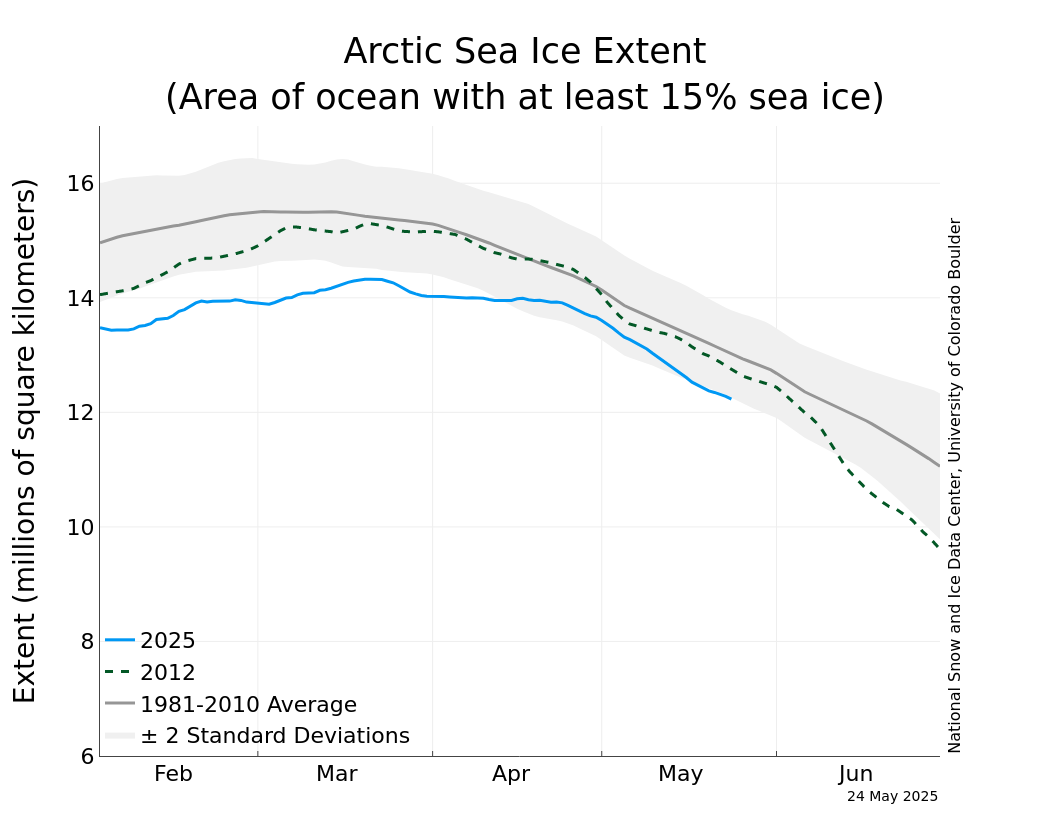
The Earth gives us an Earth Day present - highest Arctic sea ice in 8 years


As of today, JAXA shows that we have more ice than any time on this date for the past 8 years of Aqua satellite measurement for this AMSRE dataset. Yes, it isn’t much, but if this were September, and the sea ice minimum was down by this much compared to all other years, you can bet your sweet bippy we’d see it screamed in news headlines worldwide.

Of course some will argue that it “doesn’t matter” in the context of trend, or that it’s just a “weather” blip. Let us remind our friends of such blips the next time a heat wave or a storm is cited as proof of global warming.

What can be said about the short term trend in Arctic sea ice is that for the past two years, it has recovered from the historic low of 2007. It recovered in 2008, and more in 2009. If today’s Earth Day gift is any indication, it appears that it is on track now for a third year of recovery in 2010 as we’ve been saying at WUWT since fall of 2009.

I’d show NSIDC’s current Arctic Sea Ice graph also, but their website was down earlier today, and the current sea ice graph is not updated. But Steve Goddard has made some comparison overlays that are interesting.

He writes via email:
The rest here http://wattsupwiththat.com/2010/04/22/earth-gives-us-an-earth-day-present-arctic-sea-ice-is-highest-for-this-date-in-9-years/

Posted via email from Garth's posterous

Thursday, December 31, 2009

Do gum trees and people mix?


Very interesting article from this morning's edition of The Australian, especially as we call to mind last year's Black Saturday bush fires in Victoria, and at a time when we still have a simple-minded idiot up a gum tree here in Perth because the local council, quite properly, wants to remove it because of another unfortunate characteristic of many of them, that is the fact that they can drop large branches without warning. (It's not for nothing that they are known as "widow makers.")

So I've posed this question of whether people and gum trees, (I wont use the name eucalypt because apparently the old genus Eucalyptus has now been split in two, so that not all gum trees are eucalypts anymore), actually go together a number of times in recent years.

Not so much for urban and most suburban areas where trees tend not to be planted close together over large areas intermingled with houses, but certainly for most outer-suburban and rural settings.

(Though I do have objections to the near ideological and 'nationalist' fervour that sees ugly and scraggly gum trees, that give little good summer shade, planted in street scapes where broadleaved introduced species would be much better, not only giving better shade in the hot months but also more light during winter.)

Summer fires in a Mediterranean climate anywhere are inevitable.

But we live in an environment that was changed forever by aboriginal people when they started to burn the landscape regularly tens of thousands of years ago.

Plants, (and there would have been a much greater diversity of plant types across Australia back then, with gum trees only part of a much richer mix - the palms found in isolated locations in the interior of the continent are the faint echoes of this much more biodiverse land), had to go from an environment that was burned only every so often due to lightening strikes to one that was burned several times a year by aboriginal people seeking to produce new grass growth to attract animals to be hunted.

Many did not survive this drastic change and disappeared altogether or, like those isolated palms, hung on in much smaller areas that offered them some protection from people (and of course the simultaneous slow drying of the continent).

Gums however thrived. So we now live in an impoverished environment (in terms of types of plants) dominated by a type of tree that makes fires not only more likely, but also much worse when they do happen.

And yet we have country and outer-suburban councils, driven by the new green religion, telling people they cannot remove gum trees that are close to their properties and that any tree that is planted must be native, ie a gum tree.

This is a recipe for inevitable disaster.

The Canberra fires from a few years ago were a perfect example of this.

The botanical nationalism I mentioned before required that much of the city be set in a "natural" bush setting. Many homes were thus placed within areas heavily wooded with gum trees.

When the fire started it could jump from one gum tree to the next as the volatile oils in the foliage exploded into flames and the highly inflammable leaf (and bark) litter on the ground provided even more fuel for it.

But not everywhere:
The three plantations of cork oaks on the western edge of Canberra not only survived the firestorm, but checked its advance; the stand on the northwest corner of Curtin slowed the fire and protected the homes behind, not one of which was damaged. Further up the hill, where eucalypts took over, several houses were burnt.

The ACT Department of Municipal Services notes that, unlike gum trees, "Cork oak is essentially fire resistant and the foliage results in a relatively non-flammable, low-level ground fuel".

As well as oaks, there are many trees originating in dry areas of the Middle East and southern Asia that would do the job - quinces, pistachios, pears and apricots, for example, and the ubiquitous peppercorn tree, once an inevitable feature of every rural homestead. Suitable native species include the kurrajong and several varieties of wattle and casuarina.

Non-eucalypts offer other advantages. A plantation of wet-leaf trees is more effective as a firebreak than a strip of cleared or burnt ground, since their foliage blocks flying embers. During the Canberra fire large manchurian pears in Morehead Street, Curtin, stopped flaming embers from reaching several houses.

Unlike eucalypts, whose roots release acids that limit the growth of rival plants, and whose dead leaves lie around until consumed in the next fire, leaf litter from deciduous trees rots down into compost and enriches the soil.

You can read the full article here.

My own views on native versus non-native have been undergoing a change for a few years now.

I used to be one of the ecological nationalists, but am probably not one anymore. Having read both of Peter Andrews' books - Back From the Brink and Beyond the Brink - I am not as convinced anymore that introduced is necessarily bad.

It is interesting that at a time when the government was paying farmers to remove willows from creeks and rivers, he was planting them because they helped him to restore his badly degraded creeks.

One of his points is that we do indeed have an environment that has been robbed of diversity, first by aboriginal people and then by European settlement. Who knows how many different types of palms, deciduous and evergreen trees and vines have been driven to extinction by the effects of human beings on this country?

Apparently we do have settler accounts of things like vines etc that are not there anymore, our sheep and goats and cattle having finished them off.

But certainly for areas where people have their homes I now think that at most gum trees should only be a relatively small part of a much more diverse mix of trees, whether from other parts of Australia or from overseas.

Broadleaved deciduous trees need to be brought back into this mix.

And maybe, in a sense, we can start to repair damage done to this land that started thousands of years ago and restore some of the biodiversity that has been lost.

Posted via email from Garth's posterous

Saturday, October 3, 2009

Navajo and Hopi Indians tell environmentalists they're not welcome


Interesting. A very similar thing has happened here in far north Queensland when aboriginal people realised that greenies liked trees more than people, and were quite prepared to stab them in the back by doing deals with the Labor government over the so-called wild rivers legislation.

Effectively, Labor put its political interests, ie its need for green voting preferences, ahead of the needs and rights of indigenous people.

The Wilderness Society was happy to tolerate aborigines in its precious wilderness as long as they stayed poor and didn't get in the way.

It was almost worth it to see aboriginal people protesting outside a Wilderness Society function in urban Brisbane full of the usual white inner-city living upper-middle class suspects. You know, your typical Greens voter
FLAGSTAFF, Ariz. - The leader of the country's largest Indian reservation threw his support behind the neighboring Hopi Tribe, whose lawmakers declared environmental groups unwelcome on the reservation.

Navajo President Joe Shirley Jr. and Hopi lawmakers say environmentalists' efforts could hurt the tribes' struggling economies by slowing or stopping coal mining.
 
Shirley said Wednesday that he will stand in solidarity with the Hopi Tribe, and joined Hopi lawmakers in encouraging other tribes to re-evaluate their relationships with environmentalists.

Posted via email from Garth's posterous

Guy with luxury home etc thinks poor people are happier

Of course the hypocritical wanker works for the WWF. And gee, the environmental protection racket obviously pays well!

Let's see, lives on Madagascar in a luxury home, has a $35,000 boat and sends his kids to boarding school in South Africa.

His "job" with the WWF is to oppose things like a coal mine that would give his happy little poor people a decent job themselves, and a chance to earn a decent wage for themselves and their families (though obviously no where near as much as he earns to keep them poor).

According to the WWF, this team will ensure that "government decision makers and political leaders worldwide lead the world towards a future using a cleaner energy supply."

However, can we really take these experts seriously?

In their previous documentary "Mine Your Own Business," Ann and Phelim interviewed Mark Fenn, WWF's Madagascar representative, who was leading the fight against a coal-mining project that would have provided 2,000 jobs to the impoverished village.

In "Mine Your Own Business," Fenn stated that people are happy to be living such impoverished lives. He believes they do not place a value on education, so lacking money to pay for their children's schooling is not a top priority or concern.

This, of course, couldn't be further from the truth. The average salary for people in Madagascar is a meager $100 per month, making it extremely difficult for parents to send their sons and daughters to school.

"Mine Your Own Business" featured George, an unemployed miner from Romania who thought he knew about poverty but was shocked when he saw the level of deprivation in Madagascar.

He asked Fenn the question that all humanitarians should ask, "What about the people who are very poor?"

Fenn's response has since become infamous around the world. He said that for poor people, measuring how often someone smiles is more important than wealth.

Okay, so this pretentious dickhead would be more than willing to give up the home and the boat and the private education of his children, because they'd be happier and would smile more?

I don't think so.

I think he is full of shit.

Posted via email from Garth's posterous

Friday, October 2, 2009

Australian Environment Foundation 2009 Conference


There is only one environmental organisation in Australia that takes an evidence-based approach to issues.  

The Australian Environment Foundation has its annual conference in Canberra later this month.  

Consider attending. 

For more information click on here.

Posted via email from Garth's posterous

The heart of the problem for Malcolm Turnbull & the Libs - religion


Tim Blair nails this I think. I've said exactly the same thing. Had the Coalition taken on the environmental nutcases and extremists years ago and actually engaged them in debate and thus exposed just how weakly based their scaremongering was, we wouldn't be in the mess we are today.
The politics are tough now because conservatives years ago allowed the debate to get away from them; frightened of being labelled nature-haters, they declined to attack anti-progress green arguments as they were being formed. Result: in 2009 they’re dealing with a full-blown religion, and they’re discovering that logic isn’t much of a weapon against faith.

Still, it’s difficult to have sympathy for a party containing many members who privately express doubt over climate change but only rarely voice those doubts in public. As Turnbull might advise: have the courage of your convictions.

Yes, religion never went away. It just mutated into an irrational form of environmentalism and then went completely crazy.

You see this when you point out to one of the faithful that some problem or other, say deforestation, on the available evidence, isn't as bad as they think it is.

(NUANCE ALERT! NUANCE ALERT! Nobody is saying deforestation ISN'T a problem.)

Now, you'd think this was good news wouldn't you? Well, any sane and rational person would.

But not your average greenie!

The idea that anything might not be as bad as they want to believe it is only produces dumb anger and incomprehension.

They almost get off on their own negativity.

And there's the rub. Malcolm Turnbull is at heart a believer in the new religion.

Posted via email from Garth's posterous

The Not Evil Just Wrong blog - the true cost of global warming hysteria


Have a look. Now! Off you go.

Posted via email from Garth's posterous

Sunday, September 6, 2009

China's Dongtan: the eco-city that never was

From Greenie Watch:

China’s big, impractical eco-city was all greenwash but it fooled lots of people for a long time

It was nice while it lasted, but now, it seems, the dream is over. The long-awaited, much-feted eco-city of Dongtan – described by environmental campaigner, Herbert Girardet as ‘the world’s first eco-city’ – has bitten the dust. After four years of presentations, proposals and puff, the universal praise has proven to be a little premature.

.....

Admittedly, a multi-million dollar bridge from the island to Shanghai is nearing completion, which ought to open up the Dongtan region for development, but fingers are being pointed at a range of suspects for the collapse of the overall project: the corruption of local politicians, the use of challenging technologies, lapsed planning permissions, or the greed of major international consultancies that were riding in on the Chinese urban goldrush with little regard for practical niceties.

There are undoubtedly elements of truth in all of these claims, but why did no one spot that nothing was happening? The simple fact is that nobody ever questioned the hype.

.....

Now, it seems that the process is all over, environmental commentators are having to save face without sounding too contrite. After all, they were simply taken in, weren’t they? Journalist Fred Pearce sums up the situation: ‘We all wasted our time; burned carbon flying to Shanghai to relay a false prospectus to the world. If I sound bitter, I am. This time, I was a personal victim of greenwash.’

It wasn’t his fault, of course. After all, given that this project was promoted for its environmental credentials, why on earth would a journalist of Pearce’s standing ever have questioned anything? His role was simply to visit and throw garlands.

.....

Dongtan, the city that was intended to be the ‘model for how to build sustainable cities worldwide’ should still provide a lesson for us all. Blindly praising its environmental credentials without recognising its squat, low-rise, parochial, carbon-fetishising, architecturally unappealing, unworkable urban eco-clichés, is a recipe for future disasters.

SOURCE

Posted via email from Garth's posterous

Greens senator in wild assertions shock!


Siewert handed out photographs which she said proved her assertions, one of them showing reefs and mangroves on which she said the oil would have a devastating impact.

Then she watched with satisfaction as excited journos rushed to file stories.

It was, as it turned out, nonsense. The slick was nowhere near the coast. The nearest oil was actually 148km from the coastline.

But when Siewert grudgingly admitted five days later that what she had thought was oil could be algae, there was virtually no media coverage. As a result, many people still believe her original statements were true. All care and no responsibility. Who said it's not easy being Green?

Courier Mail

Via Greenie Watch

Posted via email from Garth's posterous

Thursday, July 30, 2009

World's Greenest Houses - self-indulgent hobbies for rich people


Saw my first episode tonight, and it was pretty much as I expected, that is, fantastically expensive homes of very well-off people with a lot of greendressing thrown in.

I'm going to focus of the house in San Francisco.

First thing I'd say about it is - it was wonderful!

I'd seriously consider killing someone for that place.

Now I realise that it is the wealthy who often blaze the trail when it comes to innovative new ways of doing things, and that for many of these the real costs come down over time if they are more generally adopted.

So some of what the series showcases may very well prove to have long term and wider applicability to housing and help to make houses that are more energy and resource efficient.

But dear oh dear, the program has middle-class posturing and moral smugness to burn.

I'd be very interested in the results of real cost accounting for many of these places and to see just how money saving they really are.

As an example of the often naive assumptions and refusal to properly account for real through life costs, there is the wind turbine attached to this particular home.

The first we lay eyes on it reveals the conundrum of these things. It was still.

So no wind means it is producing no power.

This means it is not producing savings in electricity consumption to help pay for its cost.

And what a cost! Between $20,000 and $30,000 just for one domestic grade windmill. (How much did the entire house cost? Most of the homes I saw tonight would easily have cost much more than an average family home.)

The rather annoying host of the program happily informs us that it will eventually pay for itself.

However, the operative word here is eventually.

I seriously doubt this figure would be recouped by the time the owner had grown old and died.

This of course points to the general problem with wind power. It is not as the compare said "free energy" at all. Compared the conventionally generated electricity, the power produced by wind turbines is actually very expensive. Once you factor in all the actual costs.

That's because they are very expensive to make, install and maintain and all for intermittent electricity generation totally dependent on the wind blowing.

Oh, and dependent on the wind not blowing too hard, when turbines have to be turned off so they don't suffer any damage and don't produce too much electricity that may overload the system.

(On a large scale, this is why Great Britain has spent over 2 billion pounds on wind farms that produce little more than 1% of the country's net energy needs.)

I also suspect that the turbine would have to be replaced or have a major overhall long before it started to produce any net savings to the home owner, and thus set her back to pretty much where she was originally.

But such is green economics within what is still essentially a religious movement for wealthy dilettantes.

Posted via email from Garth's posterous

Wednesday, July 22, 2009

While Exxon-Mobil pays $23 million to sceptics...


...billions and billions and billions of dollars flows the other way.
 
 
And this doesn't count the billions of dollars in income that the marketers of fear like Greenpeace and the WWF have made in trading on climate change concerns.
 
The WWF internationally took only five years up to around 2005 to make over $2 billion US. Greenpeace took twice as long to make a similar amount of money.
 
Extraordinary amounts of money in anybody's language.
 
As I understand though, the WWF no longer publishes its accounts online. Wonder why?
 
And yet it is the chicken feed handed out by Exxon-Mobil that everybody talks about.
 
Ask yourself this though, who has all of the high-profile and very well paid spokespeople? It isn't the sceptics is it?
 
Here in Australia the only people who's full time job it is to speak and lobby about climate change, whether for Greenpeace or the WWF or the Climate Institute etc, are all on the alarmist side.
 
Whereas the sceptics are either that unusual beast, a conservative journalist like Andrew Bolt or people, very often retired, blogging in their spare time.
 
There are powerful transnational interests seeking to influence the debate on climate change, (or more accurately, seeking to prevent any debate), which are very well funded. They are Greenpeace, the WWF and similar organisations.
 

Posted via email from Garth's posterous

Monday, July 20, 2009

Clive Hamilton sits in the lotus position and chants Omm


image
Global warming alarmist and authoritarian Clive Hamilton has left planet Earth - or been expelled:
So I think where we’re going is to begin to see a Gaian earth in its ecological, cybernetic way, infused with some notion of mind or soul or chi, which will transform our attitudes to it away from an instrumentalist one, towards an attitude of greater reverence. I mean, the truth is, unless we do that, I mean we seriously are in trouble, because we know that Gaia is revolting against the impact of human beings on it.
 
Hamilton has found not science but a neo-animist faith - and one that’s hostile to humans, as well as to reason. Note how the ABC presenter laps it up.
 
 
Said it before, I'll say it again. Climate alarmism has more to do with religion than science, and this proves it.
 
People like Hamilton resemble fundamentalist Christians concerning evolution. Science for them is something to be used to validate what they already "know" to be true, not a tool to test the validity of what they believe.
 

Posted via email from Garth's posterous

Wednesday, July 15, 2009

Urgent action needed before the lights go out in Britain


Wind farms will be a monument to an age when our leaders collectively went off their heads

Let us be clear: Britain is facing an unprecedented crisis. Before long, we will lose 40 per cent of our generating capacity.
 
And unless we come up quickly with an alternative, the lights WILL go out. Not before time, the Confederation of British Industry yesterday waded in, warning the Government it must abandon its crazy fixation with wind turbines as a way of plugging this forthcoming shortfall and instead urgently focus on far more efficient ways to meet the threat of a permanent, nationwide black-out.
 
There are a few contenders for the title of the maddest thing that has happened in our lifetime. 
 
But a front-runner must be the way in which politicians of all parties have been seduced by the La-La Land promises of the wind power lobby.
 
If you still haven't made your mind up about wind power, just consider some of the inescapable facts - facts which the Government and the wind industry do their best to hide from us all.
So far we have spent billions of pounds on building just over 2,000 wind turbines - and yet they contribute barely one per cent of all the electricity that we need.
 
The combined output of all those 2,000 turbines put together, averaging 700 megawatts, is less than that of a single, medium-sized conventional power station.
 
The rest here.
 

Posted via email from Garth's posterous

Sunday, July 12, 2009

Other than that, Rann’s paragraph is largely accurate


South Australian Premier Mike Rann today demonstrates that the worst rubbish isn’t plastic bags, but what’s said about them by green alarmists:
Every year, four billion of these bags are dumped into Australia’s environment, clogging landfill or choking the nation’s waterways. By stopping this in South Australia, that’s 400 million bags a year that won’t be causing massive environmental damage.
 
Fact check on just this one paragraph of his wild piece:
1. No, 4 billion plastic bags aren’t just “dumped” on our environment each year. A Productivity Commission study estimates just 0.8 per cent of them become litter.
 
2. This, of course, means that South Australia is not removing 400 million bags that cause “massive environmental damage”. It’s in fact removing fewer than 4 million bags which end up as litter, and cause only an arguable amount of “damage”.
 
3. No, the nation’s waterways aren’t “choked” by plastic bags. Look for yourself.
 
4. In fact, the Productivity Commission reports that plastic bags, rather than “clogging” landfills, seem have “landfill management benefits including stabilising qualities, leachate minimisation and minimising greenhouse gas emissions”.
 
5. It seems that the “massive environmental damage” done by plastic bags has actually been massively overstated by green groups, many of which have wildly misrepresented and exaggerated the effect of bags on wildlife.
 
6. Removing plastic bags may in fact cause more inconvenience and even environmental harm than leaving shoppers be, again according to the Productivity Commission study.
 
Other than that, Rann’s paragraph is largely accurate.
 
 
And let's be kind to Rann and assume he's not an opportunistic liar, just an ignorant idiot who actually believes the rubbish that comes out of his mouth.
 

Posted via email from Garth's posterous

Tuesday, June 30, 2009

I am charged with treason against the planet. Sweet!


Honest though Guv', I didn't know I's was working for them dirty Martians! Honest!
 
The Bolter takes up my defence:
 
Again, I ask: if the evidence for catastrophic man-made global warming is so clear, why the exaggerations, lies and absurd abuse?
 
That abuse grows even wilder as the alarmists’ case crumbles. Take Nobel [economics] laureate Paul Krugman:
And as I watched the deniers make their arguments, I couldn’t help thinking that I was watching a form of treason — treason against the planet.
We now owe allegiance to the planet?  And can commit treason against Mother Earth? Wow.
 
So what’s Krugman’s evidence for catastrophic temperature rises?
The fact is that the planet is changing faster than even pessimists expected: ice caps are shrinking, arid zones spreading, at a terrifying rate.
But as Thomas Fuller points out:
If these are the reasons he cries treason, he should perhaps reconsider. One ice cap shrunk, as it has before, but is recovering, as it has before. The other ice cap is growing at the rate of 10,000 square kilometers per year. As for deserts, both in China and Africa deserts are actually shrinking.
 
[And tropical rain forests are increasing, as this article from The New York Times reports.]
Then there’s the alarming reports from a conference in Copenhagen of alarmist scientists (who want us to use less of the gases they just blew out the back of their jets to get to yet another warming jamboree):
The world faces a growing risk of “abrupt and irreversible climatic shifts” as fallout from global warming hits faster than expected, according to research by international scientists released Thursday. Global surface and ocean temperatures, sea levels, extreme climate events, and the retreat of Arctic sea ice have all significantly picked up more pace than experts predicted only a couple of years ago, they said.
In fact, says distinguished climatologist Professor Roger Pielke Sr, none of that seems true.
 
image
 
Niche modeller David Stockwell and Lucia both note tricks with graphs that fed the Copenhagen claim that the world was heating as fast as ever.
 
UPDATE
David Evans describes the meeting in which Climate Change Minister Penny Wong tried to answer Steve Fielding’s three questions. It’s scary to think the Rudd Government believes so much in a theory it’s had so much trouble defending, or even understanding.
 
UPDATE 2
One of the world’s biggest emitters won’t be following Kevin Rudd’s lead and killing jobs to “save” the planet:
India cannot and will not take emission reduction targets because poverty eradication and social and economic development are first and overriding priorities,” a statement on behalf of Environment Minister Jairam Ramesh said.
The world’s biggest emitter, China, will not cut its own gases, either. So exactly who will our useless sacrifice inspire? And to what puny effect?
 

Posted via email from Garth's posterous

Sunday, June 14, 2009

F*ck me, it is a religion!


Every so often, environmentalists say something that inclines one to view their mission as more religious than ecological:

Observe an eco-sabbath. For one day or afternoon or even hour a week, don’t buy anything, don’t use any machines, don’t switch on anything electric, don’t cook, don’t answer your phone, and, in general, don’t use any resources. In other words, for this regular period, give yourself and the planet a break. Keep your regular eco-sabbath for a month.

The same post proposes a “tithe”, urges environmentalists to “sing together”, asks that they dedicate themselves to “eco-service” and finally preaches:

Believe with all your heart …

Testify!

Posted via email from Garth's posterous